
Integrating reflective learning and self-recording videos into English lessons: An eight-year collective-case study in Vietnam
DOI:
https://doi.org/10.65956/ltlt.2026.10Keywords:
self-recording videos, oracy, reflective learning, rural studentsAbstract
English has played a pivotal role in the Vietnamese education curriculum since 2008. However, teaching oral English is one of the greatest challenges in Vietnam, especially teaching students in regional areas of central Vietnam. The positive effects of Reflective Learning (RL) and Self-Recording Videos (SRVs) in teaching English have been widely reported; however, little research attention has focused on the attitudes of Vietnamese students from economically disadvantaged backgrounds towards learning activities that incorporate RL and SRVs for English language development. Through an eight-year collective-case study, we address this important gap. In this paper, we provide the rationale for educators to integrate RL and SRVs into learning activities and explain how we integrate RL and SRVs into English lessons. Drawing on qualitative data collected from sixty-five first-year students and eighty-seven second-year students between 2018 and 2025, we demonstrate that by integrating RL and SRVs into learning activities, English-speaking educators from overseas, such as those based in Australia, can motivate Vietnamese rural students to engage in learning English online every day over nine weeks. We provide insights into learners’ attitudes towards learning activities that incorporate RL and SRVs. We offer actionable strategies for educators to create an effective English language course and a novel way of developing students’ oracy skills in under-resourced TESOL contexts.
INTRODUCTION
In 1995, twenty years after the end of the war, when the US President Bill Clinton announced the diplomatic recognition of the Socialist Republic of Vietnam (Rielly, 2023), many Vietnamese started to learn English. In 2008, recognizing the vital role of the English language in Vietnam’s economic development, the government of Vietnam announced the National Foreign Languages Project, known as “2020 NFLP” that made English a compulsory subject From Grade Three of primary school upwards in all schools in Vietnam (Nguyen et al., 2025). According to the 2020 NFLP as stipulated in Decision No.1400/QD-TTg, by 2020 university graduates should be able to communicate in English independently and confidently (The Prime Minister of Vietnam, 2008). However, in 2017, the deadline of the 2020 NFLP was extended to 2025 (Tran, 2021). In 2018, almost eighty percent of more than 800,000 students who took the English test for university entrance exams scored well below the standard of the 2020 NFLP (Australian Government, 2018). In recent years, “the Ministry of Education and Training (MoET) has issued the National Foreign Languages Project 2030 on English teaching innovation, with a special focus on developing oral communicative competence” (Nguyen & AlSaqqaf, 2023, p. 343).
Researchers have reported that limited resources, lack of trained educators, and crowded classrooms were the impediments to the timely achievement of the goals of the 2020 NFLP (Dang et al., 2021; Nguyen, 2017). Teaching oral English skills is one of the greatest challenges in Vietnam (Tran, 2020). These challenges are more pronounced in areas outside the major cities (Dang et al., 2021; Nguyen, 2017). To assist disadvantaged students in their learning of the English language, we have set up courses and taught online reflective concept and oracy in English using Self-Recording Videos (SRVs) to over 200 students in central Vietnam (Tran et al., 2024a; Tran et al., 2019).
This study demonstrates how educators can teach oral English through reflective learning and SRVs. It has the potential to offer educators and curriculum planners practical strategies to implement an effective online English course. The findings of this study will expand the reflective learning and sociocultural theory literature in developing learners’ oracy skills in the TESOL context. This study is timely because of the growing number of Vietnamese people required to communicate in English. In 2025, the MoET announced Decision No.1600/QD-TTg (The Prime Minister of Vietnam, 2024), that aims to make English “a common tool for communication, learning, and working within Viet Nam’s education system” from 2025 to 2035, with a vision to 2045 throughout Vietnam (Nguyen, 2025).
This paper targets English Language teachers and learners, who are seeking actionable strategies for developing learners’ oracy skills in English. It is an account of one part of a larger interventional that aims to develop learners’ oracy skills in English through RL and SRVs. Sixty-five first-year students and eighty-seven second-year students from economically disadvantaged backgrounds in central Vietnam participated in one of our online courses between January 2018 and April 2025.
In the next section, we present the literature review, then we present the research question, followed by methodology and findings. After that we discuss the qualitative data of students’ reflection on their learning and SRV activities, the implications, the limitations, and finally, we present our reflection on our experience and recommendations.
LITERATURE REVIEW
This section presents the literature related to the study which are Reflective Learning, Oracy and Self-Recording Videos.
Reflective Learning
Reflection is a systematic and rigorous process that can help practitioners to turn experiences into meaningful knowledge for personal and intellectual growth (Rodgers, 2002). Reflection is a strategy to unearth tacit knowledge which requires a practitioner to examine an issue from multiple perspectives, self-challenge and metacognitive self-review (Cowan, 2014). Reflection can be in action, which Schön (2017) described as “thinking on our feet” because the reflecting happens amid activity, or on action which reflecting occurs after an event. Educators have used descriptive feedback to facilitate reflection-on-action with students; for example, according to Rodgers (2006) educators should ask students “to reflect on their experience as learners with such questions as: What did you learn? How do you know you learned it? What got in the way of your learning? What helped your learning? and how did you feel?” (p. 219). Rodgers (2006) explained that “there are many cultures that consider it beyond the pale to question a teacher’s decisions. This is one reason why it is so important to establish that descriptive feedback is about students’ learning and not about the teacher’s teaching. While the teacher’s teaching may be implicated, it is not the central concern. Most learners, once this is clear, are eager to share their experiences as long as they feel listened to.” (p. 220).
Researchers have reported positive outcomes by integrating reflective learning into oracy skills development (El-Garawany, 2017; Paterson, 2022). For example, El-Garawany (2017), who conducted a two-month study with eighteen fourth-year students of a Tour Guidance Department at a university in Egypt, found that peer- and self-reflection helped students of English for Specific Purposes (ESP) to significantly improve their three-minute video-recorded oral presentation skills. Paterson’s (2022) study of seven participants and two interventions of five weeks each provides evidence that “Metacognitive Reflection” and “Reflective Diary” can be used to develop oracy skills for learners who have “goal-directed behaviours, quality of strategy use and knowledge, and depth of awareness and reasoning” (p. 172). The limitations of Paterson (2022)’s study included its small sample size and the short duration of the two interventions.
Researchers have reported that reflective activities could facilitate learners’ awareness of their knowledge, enhance their confidence and assist their learning (Lozano Velandia, 2015; Suzuki, 2019). For example, according to Suzuki (2019) students who are scaffolded to learn reflection have a better understanding of learning strategies, they readily share their knowledge and learn more (Tran et al., 2024c). Lozano Velandia (2015)’s action research study with eleven flight attendant trainees in Colombia provides evidence that reflection fosters self-awareness of learners’ knowledge and goals, enhances learners’ confidence that helps them to develop specific English language functions and vocabulary for their professional interactions.
Even though scholars have reported positively the effects of reflective learning activities in oracy skills development (e.g. El-Garawany, 2017; Paterson, 2022), studies on how Vietnamese students develop oracy skills through reflective activities are scarce. This study examines the attitudes of Vietnamese students from regional areas of Vietnam towards the role of reflection in their oracy skills development. The study involves an intervention online course that scaffolds the participants to reflect-on-action on their oracy skills.
Oracy and Self-Recording Videos
There is a compelling body of research literature reporting that SRVs, team videos and general videos have successfully been used as tools to develop students’ oracy skills in English (Chen, 2021; Đinh et al., 2024; El-Garawany, 2017; Lam & Vo, 2024). For example, in the Vietnamese context, according to Lam and Vo (2024) SRVs provide a means for students to self-reflect and identify areas for improvement; they argue that on the psychological aspect, using SRVs helps students to improve speaking skills, develop learner autonomy, reduce anxiety, gain self-confidence, creativity, relaxation and excitement in speaking in English; on the academic aspect, SRVs provide an opportunity for students to practice speaking in English, help them to improve their public speaking skills, develop vocabulary, pronunciation, non-verbal communication, grammar and fluency; on the technical aspect, SRVs are easy to use as they have good internet access, phones and technical knowledge of the apps for making videos. In their study, Lam and Vo (2024) employed the quantitative research method and recruited thirty-nine students in four disciplines in one English class of a fourteen-week course at a private university in the largest city in Vietnam; the participants’ oral testing results revealed that their pronunciation had improved after conducting SRVs. The limitations of Lam and Vo (2024)’s study were that no qualitative data were collected and the participants were from Vietnam's largest metropolis.
In a case study, Đinh et al. (2024) examined the performances of Vietnamese students in creating news videos as an activity outside classes and the students’ perceptions of the effectiveness of creating news videos in developing their speaking skills over a five-week period. The students presented one news video per week from the 250 words of scripts which were created by the authors/researchers. The researchers interviewed the students about effectiveness of the activity, difficulties encountered, and differences compared to other activities. Teachers observed the students’ videos and assessed their performance in pronunciation, fluency, and coherence. The researchers reported that creating English news videos helped the students to enhance their vocabulary and improve their fluency and confidence in speaking English. The main limitation of Đinh et al. (2024)’s study was that the scripts of the participants’ speeches were prepared by the researchers.
Numerous students have perceived positively the usefulness of videos in oracy skills development (Bobkina & Domínguez Romero, 2022; Ly et al., 2024). For example, in the Vietnamese context, Ly et al. (2024) argue that YouTube motivates Vietnamese students to learn English, gives the students control over their learning, helps to improve their listening skills and their speaking skills.. The researchers recommended English educators using YouTube for assignments and homework. Ly et al. (2024)’s study limitation was that participants were 333 students of English-major at a private university in the largest city who were expected to have higher level of English proficiency than students from economically disadvantaged backgrounds at small public universities in regional areas. Therefore, Ly et al. (2024)’s findings cannot extend to students from rural areas or small towns which will be the subjects of this study.
Using SRVs to develop oracy skills has been studied by Bobkina and Domínguez Romero (2022), who employed descriptive, exploratory, non-interventionist survey research methods. In Bobkina and Domínguez Romero (2022)’s study, ninety-seven students created one-minute video pitches and presented six-minute presentations, self- and peer-evaluated the videos and the presentations; the participants were provided assessment sheets for testing and evaluating their videos and speaking skills presentation; according to their answers to the survey questions about their oracy skills development, they perceived that oral and video presentations are effective tools for developing their oracy skills; they liked to self-assess their presentations; they had positive perceptions on peer-assessment; they highly valued the possibility of reflecting upon their presentations and learning from their mistakes via videos. The main limitation of this study was the participants were engineering students in Spain.
In short, the existing literature has revealed that SRVs, team videos and general videos have been successfully used to develop learners’ speaking skills (Đinh et al., 2024; Lam & Vo, 2024) and study of reflection in TESOL has demonstrated that RL improves leaners’ speaking skills (El-Garawany, 2017; Paterson, 2022). Researchers have also reported that students perceive positively the usefulness of videos in oracy skills development (Bobkina & Domínguez Romero, 2022; Ly et al., 2024). Although numerous studies have been conducted on RL and SRVs in oracy skills development, little research has been done on the attitudes of Vietnamese students from socially and economically disadvantaged backgrounds towards learning activities that incorporate RL and SRVs on their English language development and there are limited published papers available that refer to the teaching of oracy online (Marcum & Kim, 2020).
RESEARCH QUESTION
Oracy is an essential skill for all language learners. In this study, the intervention was delivered online, and we used all three types of videos, SRVs, team videos, and general videos, to develop students’ oracy skills. To address the limitations of Lam and Vo (2024)’s case study, the intervention in this study used qualitative research methods. To address the limitations in Đinh et al. (2024)’s study, participants in this study wrote their own scripts for their speeches. To address the limitations in Ly et al. (2024)’s study, participants in this study were from regional areas in central Vietnam.
This paper is part of a larger action research project (Tran et al., 2022; Tran et al., 2024a; Tran et al., 2024c; Tran et al., 2019). In this paper, the research question was:
What are regional Vietnamese students’ attitudes towards learning activities that incorporate Reflective Learning and Self-Recording Videos to develop their oracy skills?
METHODOLOGY
This study is grounded in Vygotsky (1978)’s Sociocultural theory of learning as this theory has successfully informed many researchers in their studies of oracy skills development (Chen, 2021; El-Garawany, 2017; Marcum & Kim, 2020).
Vygotsky (1978) states that learning occurs through interaction with others who are skilful and able to help the learner to construct new knowledge by providing support and scaffolding learners based on their existing knowledge (Vygotsky, 1978). “Social interaction plays a vital role in helping learners move through the zone of proximal development and become fully autonomous and mature in the social norm or skill they are learning, including language” (Marcum & Kim, 2020, p. 151). Vygotsky’s Sociocultural theory has informed many researchers in their studies of oracy skills development (Chen, 2021; El-Garawany, 2017; Marcum & Kim, 2020). Thus, this study includes peer learning activities as described in the next section.
A qualitative case study approach is employed in this study because according to Flyvbjerg (2011), “predictive theories and universals cannot be found in the study of human affairs. Concrete case knowledge is therefore more valuable than the vain search for predictive theories and universals” (p. 304). Qualitative data can provide valuable insights into the perceptions of the learners. It can offer a deeper understanding and contextualization of the findings that can shed light on the unique experiences of individuals and the contextual factors.
Context of the Study
Numerous studies have reported that Vietnamese students experience difficulties with oral presentations and speaking in English (Dang et al., 2021; Nguyen & AlSaqqaf, 2023; Pham et al., 2022). In December 2023, the MoET reported that: “Vietnamese students have strengths in reading and listening skills but face difficulties with speaking as their average speaking score for the TOEFL exam is 14/30 and for the IELTS test is 5.8.” (Voice of Vietnam, 2023). These issues are more pronounced in regional areas of Vietnam due to lack of classroom time and limited opportunities for students to use English outside classrooms (Dang et al., 2021; Do, 2023). Most students from rural areas have low motivation in their learning the English language and low confidence in their abilities in speaking in English (Pham, 2021).
An ability to give speeches in English is a compulsory requirement for most university graduation in Vietnam as this is a required skill for many professions because “the ultimate goal of NFLP 2020 was that most Vietnamese students graduating from secondary and vocational schools, colleges, and universities would be able to independently and confidently use a foreign language (primarily English) in their daily communication, study, and work in an integrated multilingual multicultural environment, turning foreign languages into a strength of Vietnamese graduates to serve national industrialization and modernization (Prime Minister, 2008). This acknowledges foreign languages as essential soft skills needed for Vietnamese people’s communication, further study and very importantly, for employability.” (Tran et al., 2024b, p. 9). This study involves an intervention online course which we will discuss next.
The Intervention Online Course
The intervention was delivered online by both authors via Moodle since 2021 and via Facebook in 2018 and 2019 from Australia to nine cohorts of students, who were living in central Vietnam. The duration of the course was five weeks for the first cohort in 2018, seven weeks for the second cohort in 2019, nine weeks for four cohorts between 2021 and 2024 and ten weeks for three cohorts in 2025. The participants were expected to study daily. If a participant faced unexpected issues, they were instructed to complete the learning activities as soon as possible. The participants studied individually as well as with a member of their team. When possible, teams were formed voluntarily by the participants. The minimum team size was two members and the maximum was five.
There were six assignments in total. This paper focuses on the fourth lesson which scaffolded the learners to reflect on their performances in previous lessons and take action to improve their speeches as best as they can.
The learning outcomes for Lesson Four were:
- The learners were scaffolded to make a speech of two-to-three minutes. The aims were to build the learners’ confidence in giving speeches in English.
- The learners watched model videos of native-English speakers and peers’ videos. The aim was to scaffold the learners to develop oracy skills from exemplars and to learn from peers.
- The learners make at least one SRV about their personalities and study processes. The aim was to build the learners’ confidence in speaking in English and to improve their fluency in delivering short speeches of their own writings to a small group of audiences.
- The learners practiced reflection. The aims were to scaffold the learners to reflect-on-action (Schön, 1983) and to evaluate. The participants learnt evaluation using Brookfield (1995)’s Critical Incident Questionnaire (CIQ). The CIQ has been widely used to help educators to get students “to focus on specific, concrete happenings that were significant to them” (Brookfield, 1995, p. 114). We adapted the CIQ as an instrument to collect data as it has high validity, reliability and been widely used by educators and researchers (Gilstrap & Dupree, 2008; Phelan, 2012). The CIQ was designed for students to answer anonymously. In this study, we want participants to be open to other members about their evaluation. Questions 6 and 7 below were adapted from the CIQ. The participants’ answers for these two questions are used in this paper.
The instructions and questions were:
- Write at least one sentence with the word “describe” in it.
- Write at least one sentence with the word “analyse” or “analyze” in it.
- Write at least one sentence with the word “transform” in it.
- Write at least one sentence with the word “act” in it.
- Write at least 50 words about the native-English speaker’s video (or videos) that you like best. You should provide a rationale for your choice.
- What action that anyone took during this online course did you find most affirming and helpful?
- What action that anyone took during this online course did you find most puzzling or confusing?
- How many hours did you study online this week and last week with us (i.e total number of hours during the last two weeks)? If you have not kept a record of the time of your study, then please estimate the number of hours you studied this week and last week.
The participants in 2015, Cohorts Seven, Eight and Nine, attended a ten-week course. During the last week of the course, they were asked to answer the following reflective questions adapted from (Rodgers, 2006)’s questionnaire (p. 219) to guide reflection.
The rationale for using Rodgers (2006)’s questionnaire as an instrument to collect data is that it has been validated by many researchers (Barnhart & van Es, 2015; Rodgers, 2018). Moreover, the participants are Vietnamese, originating from a high power-distance and strongly collectivist Confucian culture (Le, 2022; Ngoc & Iwashita, 2012). They are often characterized as passive learners (Dang, 2010), reflecting cultural norms that emphasize respect for teachers and discourage challenging elders (Nguyen et al., 2025):
- What did you learn in Lesson Four?
- How do you know you learned it?
- What got in the way of your learning during those two weeks of Lesson Four?
- What helped your learning during those two weeks of Lesson Four?
- How did you feel during those two weeks of Lesson Four?
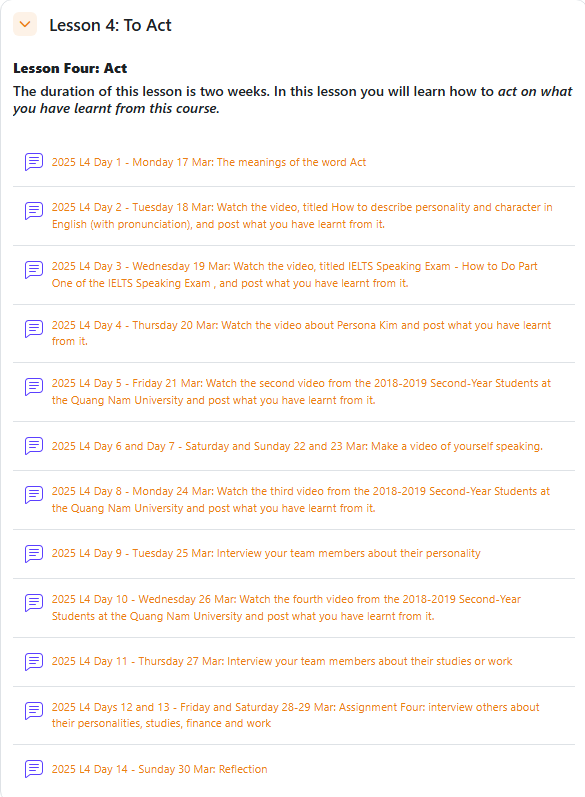
In sum, Lesson Four scaffolded students to develop their oracy skills in English by incorporating Reflective Learning and Videos into learning activities. As listed in Figure 1, participants watched videos about personalities and study processes by English speakers from the UK, the US and Australia (Lesson Four: Day Two, Day Three and Day Four); they watched sample assignment videos made by Vietnamese students of prior classes (Lesson Four: Day Five, Day Eight and Day Ten); they were instructed to make individual videos of their speeches from their earlier textual assignments and interview their peers (Lesson Four: Day Six and Seven, Day Nine, Day Eleven and Twelve, and Day Thirteen) (Tran et al., 2024c). All participants’ SRVs were posted on Facebook private group for other students to watch and to evaluate in Lesson Five. All participants, reported in this paper, made at least one video of their speeches (Lesson Four: Day Six and Seven). Some participants also made videos interviewing members of their team (Lesson Four: Day Nine or/and Day Eleven and Twelve, or/and Day Thirteen).
Participants
One hundred and fifty-two students participated in the study between 2018 and 2025. Sixty-five first-year students and eighty-seven second-year students. Fifty-three participants were first-year students who studied English as their major at Quang Nam University, a small university located in a small town in central Vietnam. Twelve participants were first-year students of Primary Education at Da Nang University. Eighty-five participants were second-year English major students at a small university in central Vietnam. Two participants, from economically disadvantaged backgrounds, were second-year students at two different universities in Da Nang and English was not their major.
All participants, except one, were introduced to the authors by two teachers at two universities in central Vietnam. One participant, who was from the economically disadvantaged backgrounds, was introduced to the authors by a Vietnamese friend. The authors have no relationship with any of the participants. The participants were divided into nine cohorts as shown in Table 1. Two participants were male. All others were female. Participants were aged between eighteen and twenty-five years old. They were from regional areas or mountains or economically disadvantaged backgrounds in central Vietnam. As per Tran et al., (2024c)’s study, all participants gave consent for their data to be used for research purposes and publication of papers. They participated in the study as extracurricular activities without gaining any credit from their university course. The intervention course was free, and participants can stop participating at any time (Tran et al., 2024c).
Data Collection
A private Facebook group was created to provide a platform for informal communication e.g. oracy assignment deadline or link to a Zoom meeting as Vietnamese students rarely used emails for communication purposes. Data was collected on the discussion forums from the participants’ daily posts and from the participants’ SRVs which were loaded on the private Facebook group.
The script for each speech was posted as a component of the activities on Lesson Four and Lesson Six, e.g. Lesson Four Day 6 and Day 7 (figure 1). Each script had between 150 and 395 words. The duration of Lesson Four was two weeks. Please see figure 1 for a summary of the instructions for Lesson Four Day 6 and Day 7, Lesson Four Day 9, Lesson Four Day 11, and Lesson Four Day 12 and Day 13. For the first two cohorts, in 2018 and in 2019, SRVs were teamwork activities. The requirement was that each team made a team video and each member participated in their team video.
Qualitative data were collected from participants’ posts on discussion forums from 2021 to 2025. For the first two cohorts, 2018 and 2019, participants worked in teams of five each and they posted their team assignments on Facebook. This paper covers data from participants’ posts on their evaluation using Brookfield (1995)’s Critical Incident Questionnaire for all cohorts. Extract samples are in the “Findings” section. This paper also covers data posted during the last week of the course by Cohorts Seven, Eight and Nine who answered the reflective questions adapted from Rodgers (2006)’s questionnaire. Please see “the Intervention Online Course” section above for details of the questions and see the “Findings” section for samples of the posts.
Data Analysis
Thematic analyses were used to analyse participants’ posts. From the codes, themes were identified and categorised. An inductive approach was employed to group and analyse the data. From the thematic analysis codes, themes were identified and categorised using the Classical Content Analysis method (Leech & Onwuegbuzie, 2007).
Guided by the process described by Leech and Onwuegbuzie (2007), the first author read all posts. While reading she highlighted key words and key phrases. She assigned code to each key word or phrase after each reading. She re-read the posts numerous times and refined the codes as she examined them. Following the same process, the second author read nine posts from participants, one participant from each cohort. He read them multiple times and coded them accordingly. The results of the coding process by the two authors were compared and validated. Differences were discussed and agreed upon.
The first author categorised the codes at the end of the process and referenced each code to existing literature, if any. For example, the fifth category “Confidence increases at the end of the Lesson” echoes Đinh et al. (2024), Lozano Velandia (2015) and Suzuki (2019)’s findings. For further details please see the “Interpretation of the Findings” section below.
The first author then plotted the Pie Graph (see Figure 2) and wrote the paper. The second author read a draft version of the paper, provided detailed comments and checked references. The first author revised the paper for a next draft. This writing process went through multiple versions before the final submission. In the next section, we present sample extracts and sample coding analysis.
FINDINGS
One hundred students completed all required activities: one male student and ninety-nine female students. They are grouped into nine cohorts as illustrated in Table 1. The participants studied at least one hour every day for the duration of the course.
Table 1.. Participants
|
Cohort |
Year |
Year at Uni |
University in Central Vietnam |
No of Participants |
No of Participants completed |
|---|---|---|---|---|---|
|
1 |
2018 |
Second |
Small University |
40 |
35 |
|
2 |
2019 |
Second |
Small University |
40 |
35 |
|
3 |
2021 |
First |
Small University |
13 |
5 |
|
4 |
2022 |
First |
Small University |
12 |
6 |
|
5 |
2023 |
First |
Small University |
14 |
4 |
|
6 |
2024 |
First |
6 students from a small University. 12 students from a University in Da Nang. |
18 |
4 (2 sts from each uni) |
|
7 |
2025 |
First |
Small University |
8 |
6 |
|
8 |
2025 |
Second |
Small University |
5 |
3 |
|
9 |
2025 |
Second |
Non-English Major students from two different universities in Da Nang. |
2 |
2 |
The participants made between one and five videos during the course as follows:
- Seventy-three participants made one video each.
- Sixteen participants made two videos each.
- Three participants, KH, TT, TS, made three videos each.
- Three participants, TV, HAT, T, made four videos each.
- Five participants, TLAT, TH, HTN, LN, YN, made five videos each.
The duration of each video was more than two minutes and less than four minutes. Sample extracts from the participants’ reflections are reported below. The full list of data is available on request.
“Participating in the course helps me and all of the members be much more confident and happier. The course helps me to develop my English skills, especially speaking and writing skills. During the course, the moment I feel most engaged with is the time we made a video to interview group members’ characters, because it was the first time we made a video by ourselves. At that time, we had a lot of fun.” Participant in Cohort 1.
“I think the action anyone did during this course that I find most helpful is making video and describing themselves.” Participant in Cohort 4.
“I think standing in front of the camera and talking is a difficult thing for me.” Participant in Cohort 4.
“This course helped me get to know my teammates, understand each other’s personalities, and create a video together so everyone can chat, it’s great.” Participant in Cohort 5.
“The most useful action in this course is to practice filming short meaningful videos and enrich each person’s knowledge. It is so good.” Participant in Cohort 6.
“The action that someone took during this online course I found most affirming and helpful is everyone made videos about their personality, studies or work. These videos helped me better understand the lesson content and feel more connected with everyone in the course.” Participant in Cohort 7.
“What I found most affirming and helpful was making a video of myself interviewing my teammate about her personality and studies because it allowed me to practice speaking English fluently.” Participant in Cohort 7.
“The most encouraging and helpful action in this course was that everyone recorded videos to share about themselves this week. This helped me understand my classmates better, see their perseverance, and learn good pronunciation from them, which motivated me to work even harder.” Participant in Cohort 8.
“This is probably my favourite lesson because I had the chance to make a video and watch others’ videos as well. I learned a lot, from pronunciation to body language when speaking.” Participant in Cohort 8.
“I found it most affirming and helpful when people recorded videos about study, personality, and finance. Through that, I learned a lot more from everyone. I was also puzzled by the process of creating videos as it was a real challenge for me. Before I even knew how to approach it, many others had already uploaded their videos. It usually takes me at least three hours to make one video.” Participant in Cohort 9.
“I felt most engaged when I learned how to introduce myself and others confidently. I also practiced speaking and pronunciation.” Participant in Cohort 9.
Sample extracts from the participant in Cohort Seven answered the reflective questions adapted from Rodgers (2006)’s questionnaire (p. 219). The full list of data is available on request.
- What did you learn in Lesson Four?
During Lesson Four, I learnt a lot about speaking and making my own videos. By watching videos like “How to describe personality and character in English (with pronunciation)” and “IELTS Speaking Exam - How to Do Part One of the IELTS Speaking Exam.”, I knew how to apply correct pronunciation and useful expressions to my own videos. It’s really helpful for me as an English learner, especially since I rarely get a chance to record myself speaking.
- How do you know you learned it?
Through these tasks in Lesson Four, I noticed my pronunciation has improved and I am now able to make my own videos without feeling nervous or anxious.
- What got in the way of your learning during those two weeks of Lesson Four?
I think what got in the way of my learning during those two weeks of Lesson Four was the amount of time I spent making videos. I’m a kind of person who always wants everything to be perfect, so if I stumble while recording, I will start over from the beginning. For that reason, I often felt quite tired when making videos.
- What helped your learning during those two weeks of Lesson Four?
The most important thing that helped my learning in Lesson Four was seeing the effort other members out into their videos. It’s a source of inspiration for me to create my own videos like them.
- How did you feel during those two weeks of Lesson Four?
I felt very excited when I had opportunities to make videos on my own and with my friend, […]. It has been one of the most unforgettable experiences for me in this online course.
Nine categories of the regional Vietnamese students’ attitudes towards learning activities that incorporated Reflective Learning and Self-Recording Videos to develop their oracy skills have been identified from the participants’ posts. See Table 2 and Figure 2.
Table 2.. Categories vs. Number of Times the Participants Posted
|
ID |
Category |
Total number of times the participants posted |
|---|---|---|
|
1 |
Appreciation of Teamwork |
22 |
|
2 |
Learning from Peers |
21 |
|
3 |
Motivation to learn or Enjoyment in doing activities |
16 |
|
4 |
Developing Speaking Skills |
15 |
|
5 |
Confidence increases at the end of the Lesson |
12 |
|
6 |
Lack of Time to make videos |
8 |
|
7 |
Anxieties or Lack Confidence at the beginning |
5 |
|
8 |
Technical or Personality Issues in making videos |
5 |
|
9 |
First time making Self-Recording Video |
2 |
Following is an example of the analysis of the reflection posted by a participant in Cohort 1:
“Participating in the course helps me and all of the members be much more confident and happier.”: Code ID 3 – Motivation to learn or Enjoyment in doing activities; Code ID 5 – Confidence increases.
“The course helps me to develop my English skills, especially speaking and writing skills.”: Code ID 4 – Developing Speaking Skills.
“During the course, the moment I feel most engaged with is the time we made a video to interview group members’ characters, because it was the first time we made a video by ourselves.”: Code ID 1 – Appreciation of Teamwork; Code ID 9 – First time making SRV.
“At that time, we had a lot of fun.”: Code ID 3 – Motivation to learn or Enjoyment in doing activities.
Following is an example of the analysis of the reflection posted by a participant in Cohort Seven:
“I think what got in the way of my learning during that two weeks of Lesson Four was the amount of time I spent making videos.”: Code ID 6 – Lack of Time to make videos.
“I’m a kind of person who always wants everything to be perfect, so if I stumble while recording, I will start over from the beginning. For that reason, I often felt quite tired when making videos.”: Code ID 8 - Technical or Personality Issues in making videos.
Following is an example of the analysis of the reflection posted by a participant in Cohort Nine:
“I found it most affirming and helpful when people recorded videos about study, personality, and finance.”: Code ID 1 – Appreciation of teamwork.
“Through that, I learned a lot more from everyone.”: Code ID 2 – Learning from peers.
“I was also puzzled by the process of creating videos as it was a real challenge for me.”: Code ID 8 – Issues in making videos.
“Before I even knew how to approach it, many others had already uploaded their videos.”: Code ID 7 – Anxieties, lack confidence at the beginning.
“It usually takes me at least three hours to make one video.”: Code ID 6 – Need time to make videos.
As illustrated in Figure 2, the first five categories take eighty-one percent of all participants’ posts about their reflection on the lesson of making videos of their speeches. The two categories that have the highest number of posts are “appreciation of teamwork” and “learning from peers”. These findings are in line with the Sociocultural theory which states that learning takes place when learners interact with others and internalize the knowledge obtained from those interactions (Chen, 2021; El-Garawany, 2017). The third and fourth categories are “Motivation to learn or Enjoyment in doing activities” and “Developing Speaking Skills”, and the fifth category is “Confidence at the end of the lesson”. The results of the third, fourth and fifth categories echo Lam and Vo (2024)’s findings. The results of the fifth category also echo Đinh et al. (2024), Lozano Velandia (2015) and Suzuki (2019)’s findings. The sixth category is “Lack of Time to make videos” and the remaining categories are “Anxieties or Lack Confidence at the beginning”, “Technical or Personality Issues in making videos” and “First time making Self-Recording Video”. The last four categories take nineteen percent of all participants’ posts about their reflection on the lesson of making videos of their speeches.
DISCUSSIONS
The intervention has added value to the teaching of oracy skills using RL and SRVs. The positive connection between RL and the enhancement of learners’ oracy skills identified in this study aligns with the findings of the literature that integrate reflective learning and oracy lessons into activities (e.g. El-Garawany, 2017; Paterson, 2022). The findings of RL increasing learners’ confidence align with the finding in the studies of Lozano Velandia (2015), Paterson (2022) and Suzuki (2019). The positive attitudes of the participants in learning from peers are in line with the Sociocultural theory and align with the studies of Chen (2021) and El-Garawany (2017). The participants’ high motivation to learn and their enjoyment in making SRVs echo Lam and Vo (2024)’s findings. The finding that SRVs build learners’ confidence is consistent with Đinh et al. (2024)’s findings.
The implications of this study extend beyond Vygotsky (1978)’s sociocultural theory of learning to address practical changes in curriculum development. The unique feature of this collective-case study is that it expands the literature on developing learners’ oracy skills in the TESOL context by providing empirical evidence on how English-speaking educators from overseas such as Australia can successfully remotely scaffold students from regional areas of Vietnam to learn English and the positive attitudes of Vietnamese students towards learning activities that incorporate RL and SRVs.
A limitation of the study was the short duration of the intervention. Participants had only two weeks to watch sample videos and to make four videos during Lesson Four. The study was conducted during the second semester which was a stressful university study period for the participants. For example, seven percent of all posts were about “Lack of Time to make videos”. As a result, only one hundred participants out of 152 participants completed the required activities.
The participants were from regional areas or economically disadvantaged backgrounds in central Vietnam hence their access to advanced technology was limited. All participants, with two exceptions, were female – this was accidental as majority of students who studied English at the Small University were female. They were from rural or mountainous areas, or minority groups or from economically disadvantaged families. During school age, they were living in remote or rural areas of Vietnam, their schools had few resources, and they had limited opportunities to practice English. Their levels of English proficiency were low as the required English marks for their university admission were much lower than other universities. At university they had little opportunity to practice English outside classroom, and they had no contact with English speaking people. During the time they participated in this study, except for the second author, they had never interacted with English-speaking people before.
CONCLUSIONS
This study provides evidence of the impact of SRVs on learners’ oracy skills development through reflective tasks. There were nine categories of the regional Vietnamese students’ attitudes towards learning activities that incorporated RL and SRVs to develop their oracy skills. The two most positive views were teamwork and learning from peers on their oracy skills development through reflective tasks. They were able to learn new knowledge from watching their peers’ SRVs and to work with their team members to make team videos. The third and fourth positive views were that this strategy was a valuable tool for motivation and developing speaking skills. The fifth view was that it was an effective strategy for building students’ confidence in speaking in English. The first five categories which take eighty-one percent of all categories, have demonstrated that by integrating RL and SRVs into learning activities, educators from English speaking countries can motivate Vietnamese students from regional areas to learn English online with positive outcomes. The findings suggest that institutions and educators should support the implementation of RL and SRVs in language education.
The findings make valuable contributions to the field of oracy development in TESOL and in the Vietnamese context. For students, this study has demonstrated how students can develop their oracy skills in English through RL and SRVs outside classrooms. For educators and teachers, this study has provided the rationale for them to integrate RL and SRVs into learning activities to teach oracy skills in English, and it is possible for teachers to assign these activities as homework outside classroom. This study offers a novel and practical way of developing students’ oracy skills in under-resourced TESOL contexts. It gives insights to curriculum developers, policymakers and educators seeking how to create an effective English language online course for students from regional areas. It provides regional Vietnamese students’ voices about their learning experiences.
The main limitations of this study are that almost all participants were female students from regional areas in central Vietnam or from economically disadvantaged families, the time for them to learn and complete their self-recording videos was only two weeks, and no evaluations of their performances were conducted. In future studies, we will address these limitations.
ACKNOWLEDGEMENTS
We appreciate detailed comments from Dr Tin T. Dang and the anonymous reviewers. We thank 152 students who participated in our DATAE-Intro courses between January 2018 and April 2025 and gave us consent to use their data for research and publication purposes. We thank Ms. Dieu-Hien Phan for introducing her students, Ms Ngan-Thuong Dinh for introducing twelve students, and Ms Lam Nguyen for introducing one student to participate in this study.
References
Australian Government. (2018). Vietnam English language training policy update. Retrieved 7 June 2025 from https://internationaleducation.gov.au/International-network/vietnam/publications/Documents/Vietnam%20English%20Language%20Training%20Policy%20Update.pdf
Barnhart, T., & van Es, E. (2015). Studying teacher noticing: Examining the relationship among pre-service science teachers’ ability to attend, analyze and respond to student thinking. Teaching and Teacher Education, 45, 83-93. https://doi.org/10.1016/j.tate.2014.09.005
Bobkina, J., & Domínguez Romero, E. (2022). Exploring the perceived benefits of self-produced videos for developing oracy skills in digital media environments. Computer Assisted Language Learning, 35(7), 1384-1406. https://doi.org/10.1080/09588221.2020.1802294
Brookfield, S. D. (1995). Becoming a critically reflective teacher. Jossey-Bass.
Chen, K. T. C. (2021). The effects of technology-mediated TBLT on enhancing the speaking abilities of university students in a collaborative EFL learning environment. Applied Linguistics Review, 12(2), 331-352. https://doi.org/10.1515/applirev-2018-0126
Cowan, J. (2014). Noteworthy matters for attention in reflective journal writing. Active Learning in Higher Education, 15(1), 53-64. https://doi.org/10.1177/1469787413514647
Dang, T. T. (2010). Learner autonomy in EFL studies in Vietnam: A discussion from socio-cultural perspective. English Language Teaching, 3(2), 3-9. https://doi.org/10.5539/elt.v3n2p3.
Dang, T. B. D., Nguyen, M., & Hua, N. N. (2021). An investigation into difficulties in English listening of freshmen majoring in English at a university in the Mekong delta, Vietnam. European Journal of English Language Teaching, 6(6), 38-61. https://doi.org/10.46827/ejel.v6i6.3925
Đinh, T. M., Lê, H. T., & Nguyễn, T. H. T. (2024). A Study on the effectiveness of creating English news videos to enhance speaking skills for English club members at Hung Yen University of Technology and Education. VietTESOL International Convention Proceedings, 4. https://proceedings.viettesol.org.vn/index.php/vic/article/view/148
Do, A. T. (2023). Blended teaching of English speaking in a Vietnamese context: Design and procedure. TESOL Journal, 14(3), e703. https://doi.org/10.1002/tesj.703
El-Garawany, M. S. M. (2017). The effect of vlogging on developing tour guidance students’ EFL presentation skills and reflective thinking. Journal of Research in Curriculum Instruction and Educational Technology, 3(1), 43-79.
Flyvbjerg, B. (2011). Case study. In N. K. Denzin & Y. S. Lincoln (Eds.), The Sage handbook of qualitative research (1st ed., pp. 301-316). Sage.
Gilstrap, D. L., & Dupree, J. (2008). Assessing learning, critical reflection, and quality educational outcomes: The critical incident questionnaire. College & Research Libraries, 69(5), 407-426. https://doi.org/10.5860/crl.69.5.407
Lam, T. T., & Vo, T. B. P. (2024). Students’ perceptions of the effectiveness of self-recording videos in developing students’ speaking skills. VietTESOL International Convention Proceedings, 4. https://proceedings.viettesol.org.vn/index.php/vic/article/view/143
Le, V. C. (2022). Language teacher education in Vietnam: Looking back and looking forward. In M. S. Khine & Y. Liu (Eds.), Handbook of Research on Teacher Education: Innovations and Practices in Asia (pp. 333-350). Springer Nature. https://doi.org/10.1007/978-981-16-9785-2_17
Leech, N. L., & Onwuegbuzie, A. J. (2007). An array of qualitative data analysis tools: A call for data analysis triangulation. School Psychology Quarterly, 22(4), 557-584. https://doi.org/10.1037/1045-3830.22.4.557
Lozano Velandia, S. A. (2015). Goal-setting and self-reflection to enhance learners’ interaction in an ESP context. Latin American Journal of Content & Language Integrated Learning, 8(2), 131-160. https://doi.org/10.5294/laclil.2015.8.2.4
Ly, N. M. C., Chu, T. D., Tran, T. H. A., & Pham, Q. A. (2024). Students’ perception of using YouTube to learn English: A case study at Van Lang University. International Journal of TESOL & Education, 4(3), 20-45.
Marcum, J., & Kim, Y. (2020). Oral language proficiency in distance English-language learning. CALICO Journal, 37(2), 148-168. https://doi.org/10.1558/cj.37788
Ngoc, K. M., & Iwashita, N. (2012). A comparison of learners' and teachers’ attitudes toward communicative language teaching at two universities in Vietnam. University of Sydney Papers in TESOL (7), 25-49.
Nguyen, P. T. L., Nguyen, A. Q., Le, M. T. P., & Phan, L. T. (2025). Impacts of culture on Vietnamese students’ willingness to communicate in English classes: An implication for teaching and learning activities. Theory and Practice in Language Studies, 15(4), 1354-1362. https://doi.org/10.17507/tpls.1504.34
Nguyen, Q. (2025, May 21). Roadmap to realising the goal of bilingual education in Vietnamese schools. Nhan Dan. https://en.nhandan.vn/roadmap-to-realising-the-goal-of-bilingual-education-in-vietnamese-schools-post148318.html
Nguyen, T. (2017). Vietnam’s national foreign language 2020 project after 9 years: A difficult stage. The Asian Conference on Education and International Development, 443-464. https://papers.iafor.org/wp-content/uploads/papers/aceid2017/ACEID2017_35175.pdf
Nguyen, T. U. N., & AlSaqqaf, A. (2023). Impact of a DMGA scaffolding-based module on improving the EFL speaking skills among Vietnamese ESP learners. Arab World English Journal (AWEJ), 14(4), 342-357. https://doi.org/10.24093/awej/vol14no4.21
Paterson, R. (2022). Prompting metacognitive reflection to facilitate speaking improvements in learners of English as a foreign language. English Teaching & Learning, 46(2), 157-177. https://doi.org/10.1007/s42321-021-00086-2
Pham, H. C. (2021). English language education in rural areas: Current issues, complexities and ways forward. VNU Journal of Science: Education Research, 37(4). https://doi.org/10.25073/2588-1159/vnuer.4538
Pham, M. T., Nguyen, D. N. Q., Nguyen, T. K. C., Nguyen, H. N. M., Hoang, T. A. T., & Pham, V. P. H. (2022). The reality of English presentation skills of English-majored students in Vietnam: A case study at Van Lang University. International Journal of TESOL & Education, 2(2), 27-46.
Phelan, L. (2012). Interrogating students’ perceptions of their online learning experiences with Brookfield’s critical incident questionnaire. Distance Education, 33(1), 31-44. https://doi.org/10.1080/01587919.2012.667958
Rielly, E. J. (2023). United States recognizes Vietnam. Retrieved 18 Nov 2025 from https://www.ebsco.com/research-starters/history/united-states-recognizes-vietnam.
Rodgers, C. (2002). Defining reflection: Another look at John Dewey and reflective thinking. Teachers College Record, 104(4), 842-866. https://doi.org/10.1111/1467-9620.00181
Rodgers, C. (2018). Descriptive feedback: student voice in K-5 classrooms. The Australian Educational Researcher, 45(1), 87-102. https://doi.org/10.1007/s13384-018-0263-1
Rodgers, C. R. (2006). Attending to student voice: The impact of descriptive feedback on learning and teaching. Curriculum Inquiry, 36(2), 209-237. https://doi.org/10.1111/j.1467-873X.2006.00353.x
Schön, D. A. (2017). The reflective practitioner: How professionals think in action. Routledge.
Suzuki, H. (2019). Becoming expert learners through reflective activities. New Directions in Teaching and Learning English Discussion, 7, 192-199.
The Prime Minister of Vietnam. (2008). Decision No.1400/QD-TTg. 2008. Retrieved 29 July 2025 from https://thuvienphapluat.vn/van-ban/EN/Giao-duc/1400-QD-TTg/83815/tieng-anh.aspx
The Prime Minister of Vietnam. (2024). Decision No.1600/QD-TTg. Retrieved 29 July 2025 from https://thuvienphapluat.vn/van-ban/EN/Giao-duc/Decision-1600-QD-TTg-2024-Scheme-for-international-integration-in-education-and-training-till-2030/639772/tieng-anh.aspx
Tran, H. M. T., Anvari, F., & Phan, H. D. T. (2022). Teaching English online to Vietnamese students in a small town during the COVID-19 pandemic. VietTESOL International Convention Proceedings, 2. https://proceedings.viettesol.org.vn/index.php/vic/article/view/7
Tran, H. M. T., Anvari, F., & Phan, H. D. T. (2024a). Teaching reflection to first-year students of ESL: A three-year collective case study in rural Vietnam. VietTESOL International Convention Proceedings, 4, 210-220. https://proceedings.viettesol.org.vn/index.php/vic/article/view/166
Tran, H. M. T., Anvari, F., & Phan, H. D. T. (2024c, July). Promoting Learner Autonomy and Intercultural Competence Through Reflective Learning among First-year Students: an Action Research. Proceedings of the 12th OpenTESOL International Hybrid Conference 2024: Nurturing Open Minds, Shaping Inclusive Futures In Language Education, Ho Chi Minh City, Viet Nam.
Tran, H. M. T., Anvari, F., Phan, T. D. H., & Nguyen, T. T. N. (2019). Introducing reflective learning to second-year university English students in a rural province of Vietnam: A case study. Proceedings of the 5th International Conference on Language, Society and Culture in Asian Contexts, 1468-1481.
Tran, L. T., Nghia, T. L. H., & Ngo, M. T. (2024b). The nexus of English education and graduate employability: The need to re-position and modify the approach to English education. English Language Education for Graduate Employability, 1-24.
Tran, T. L. N. (2020). Perspectives and attitudes towards self-directed mall and strategies to facilitate learning for different learner groups. Computer-Assisted Language Learning Electronic Journal, 21(3), 41-59.
Tran, T. V. (2021). Why I don’t teach as I was trained: Vietnamese early career ESOL teachers’ experience of reality shock. Australian Journal of Teacher Education (Online), 46(12), 35-51.
Voice of Vietnam. (2023). Annual report on teaching, learning of foreign languages in Vietnam published. Retrieved 6 July 2025 from https://english.vov.vn/en/society/annual-report-on-teaching-learning-of-foreign-languages-in-vietnam-published-post1068316.vov
Vygotsky, L. S. (1978). Mind in society: The development of higher psychological processes. Harvard University Press.
Downloads
Published
Data Availability Statement
Full data is available upon request.
Issue
Section
License
Copyright (c) 2026 Hien Minh Thi Tran, Farshid Anvari

This work is licensed under a Creative Commons Attribution-NonCommercial-NoDerivatives 4.0 International License.